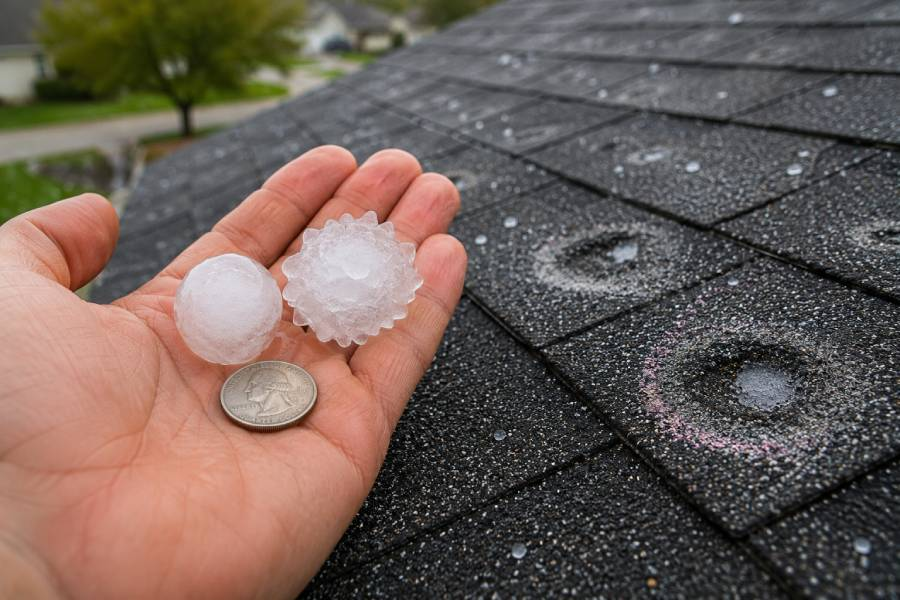
Hail does not have to be baseball-size before it becomes a concern for your roof.
A useful benchmark is 1-inch hail, which is approximately the size of a quarter. The National Weather Service uses one-inch hail as the severe-thunderstorm hail threshold and warns that large hail can damage roofs, vehicles, windows, and other property.
However, there is no exact hail size that guarantees roof damage.
The outcome depends on:
- hail diameter;
- hail hardness;
- wind;
- impact angle;
- roofing material;
- roof age;
- slope;
- existing roof condition.
If significant hail affected your property, reviewing common storm and hail damage concerns can help you understand what roofing professionals may inspect after a storm.
Hail Size Comparison Guide
The National Weather Service uses common objects to help describe hailstone diameter.
| Hail Size | Approximate Diameter | General Roofing Concern |
|---|---|---|
| Pea | 0.25 inch | Usually lower concern |
| Marble | 0.50 inch | Vulnerable materials may be affected |
| Penny/Dime | 0.75 inch | Damage becomes more possible |
| Quarter | 1.00 inch | NWS severe-hail threshold |
| Half Dollar | 1.25 inches | Increased damage potential |
| Ping-Pong Ball | 1.50 inches | Significant roofing concern |
| Golf Ball | 1.75 inches | High concern for exterior damage |
| Hen’s Egg | 2.00 inches | Potential for substantial damage |
| Tennis Ball | 2.50 inches | Severe property-damage potential |
| Baseball | 2.75 inches | Highly destructive hail |
You can review the complete National Weather Service hail size reference.
Can One-Inch Hail Damage a Roof?
Yes.
Quarter-size hail can damage roofing materials under the right conditions.
The chance of damage may increase when:
- shingles are already aged;
- roofing materials have existing wear;
- hailstones are particularly hard;
- strong winds accompany the storm;
- hail repeatedly strikes the same roof slope.
This does not mean every roof exposed to one-inch hail will be damaged.
A newer roofing system may perform differently from shingles that have already experienced years of Texas heat, sunlight, wind, and previous storms.
Can Hail Smaller Than One Inch Damage Shingles?
Potentially.
Three-quarter-inch hail carries less impact energy than golf-ball-size or two-inch hail, but other conditions can increase its effect.
For example, older shingles that are brittle or already experiencing granule loss may be more vulnerable.
Strong winds can also drive hail against roofing surfaces at an angle rather than allowing it to fall almost vertically.
So while one inch is an important severe-weather benchmark, it should not be treated as a magic line between “no damage” and “damaged.”
What Can Hail Do to Asphalt Shingles?
Hail-related effects on asphalt shingles may include:
- displaced granules;
- indentations;
- bruised areas;
- cracks;
- tears;
- exposed asphalt;
- edge damage.
Hail can also affect other exterior roofing components such as:
- vents;
- flashing;
- gutters;
- downspouts;
- metal roof accessories.
Not every mark on a shingle is necessarily hail damage.
Normal weathering, foot traffic, manufacturing marks, tree debris, blistering, and other conditions can sometimes create marks that look similar.
A proper evaluation considers the pattern and condition across the roof.
Why Hail Hardness Matters
Two hailstones can be the same diameter but behave differently when they hit a roof.
The Insurance Institute for Business & Home Safety has conducted laboratory and field research into how hail properties affect asphalt shingles.
Its testing considers hail size, strength, impact energy, and the way shingles experience dents, tears, and granule loss.
For technical information, review the IBHS research on asphalt-shingle hail impact resistance.
This research is another reason homeowners should avoid judging roof condition based solely on hailstone diameter.
Why Wind Can Make Hail More Damaging
Hail does not always fall straight downward.
Thunderstorm winds can push hail sideways and drive it into roof slopes, siding, windows, gutters, and other building components.
That changes:
- impact angle;
- which roof slopes receive the most impacts;
- how fast hail strikes exposed surfaces.
A roof facing the wind may therefore experience a different pattern than another side of the same building.
Does Roof Age Affect Hail Resistance?
Yes.
Asphalt shingles gradually experience:
- ultraviolet radiation;
- summer heat;
- rain;
- wind;
- temperature changes;
- previous storms;
- ordinary material aging.
Older shingles may therefore react differently to hail impacts than newer materials.
However, being newer does not make a roofing system immune to hail.
Large, hard, or wind-driven hail can affect roofing materials of many ages.
Can Hail Damage a Roof Without Causing a Leak?
Yes.
This is one of the most important things homeowners should understand.
Roof damage does not always create an immediate interior leak.
An impact could damage or weaken a roofing material while the roof remains temporarily watertight.
Additional rain, wind, temperature changes, and normal weather exposure may later make the problem more noticeable.
If water begins entering after a storm, professional roof repair evaluation can help determine whether the issue is localized or part of broader storm damage.
Does Golf-Ball-Size Hail Damage Roofs?
Golf-ball-size hail measures approximately 1.75 inches in diameter according to the National Weather Service.
Hail of this size should be taken seriously.
It can potentially affect:
- shingles;
- roof vents;
- gutters;
- flashing;
- siding;
- vehicles;
- other exposed surfaces.
Even if there is no immediate ceiling leak, a roof exposed to hail around this size may be reasonable to have professionally evaluated.
What About Two-Inch Hail?
Two-inch hail is significantly larger than the NWS severe-hail threshold.
IBHS uses both 1.5-inch and 2-inch laboratory-manufactured hailstones as part of its asphalt-shingle impact testing.
The purpose of that testing is to understand how real roofing products respond to relevant hail impacts.
Two-inch hail should therefore be considered a significant roofing and exterior property concern.
Does Hail Automatically Mean You Need a New Roof?
No.
This is an important distinction.
A hailstorm can result in:
- no meaningful roofing damage;
- localized repairable damage;
- damage to only certain slopes;
- widespread roof damage.
A decision about replacement should consider actual roofing condition rather than simply hail size.
If damage affects a significant portion of the roofing system, a professional roof replacement evaluation may help determine whether continued localized repairs remain practical.
What Should You Check After a Hailstorm?
You can look for signs of storm impact without climbing onto your roof.
From the ground, check for:
- missing shingles;
- roofing debris;
- dented gutters;
- damaged downspouts;
- fallen branches;
- damaged siding;
- damaged window screens;
- visible displaced materials.
Inside the home, look for:
- ceiling discoloration;
- damp areas;
- dripping water;
- moisture around roof penetrations.
Avoid climbing onto a wet or damaged roofing system.
The safest way to determine the roof’s condition is through a professional evaluation.
What Are Impact-Resistant Shingles?
Some asphalt shingles are designed to provide improved resistance to hail impacts compared with standard products.
That does not mean they are hail-proof.
Performance still depends on:
- hail size;
- hardness;
- wind;
- installation;
- age;
- product design;
- repeated storm exposure.
IBHS tests commercially available asphalt shingles using controlled laboratory impacts to compare how different products respond.
Homeowners replacing a roof in a hail-prone area may want to ask about the cost, warranty, expected performance, and insurance considerations associated with impact-resistant materials.
Understanding Hail Damage Risk
There is no universal hail size that guarantees a roof will be damaged.
However, one-inch, quarter-size hail is an important threshold because it meets the National Weather Service criterion for severe hail. Larger hail generally creates greater concern, particularly as hail approaches ping-pong-ball, golf-ball, or two-inch sizes.
Hail size is only one part of the equation.
Roofing material, condition, age, hail hardness, wind speed, storm direction, and impact angle can all affect the result.
The most reliable approach after a significant hailstorm is to evaluate the actual roofing system rather than assuming the roof is fine—or assuming it automatically needs replacement.
Frequently Asked Questions
What size hail usually starts damaging roofs?
There is no guaranteed damage threshold, but one-inch hail is an important benchmark. The National Weather Service classifies one-inch, quarter-size hail as severe, and roofing damage becomes a more significant concern as hailstones grow larger.
Can three-quarter-inch hail damage shingles?
It can under some conditions. Older or already deteriorated materials may be more vulnerable, and strong winds can increase the severity of impacts. Smaller hail generally has less impact energy than larger hail, so actual damage varies by property and storm.
Can a roof have hail damage without leaking?
Yes. Hail may weaken or damage roofing materials without immediately creating a path for water. The damage can become more noticeable after later rain, wind, temperature changes, or continued material deterioration.
Does hail damage always require a complete roof replacement?
No. Some roofs may have no significant damage, while others may only require localized repair. Replacement becomes more relevant when physical damage is sufficiently widespread or the roofing system is no longer reasonably repairable.