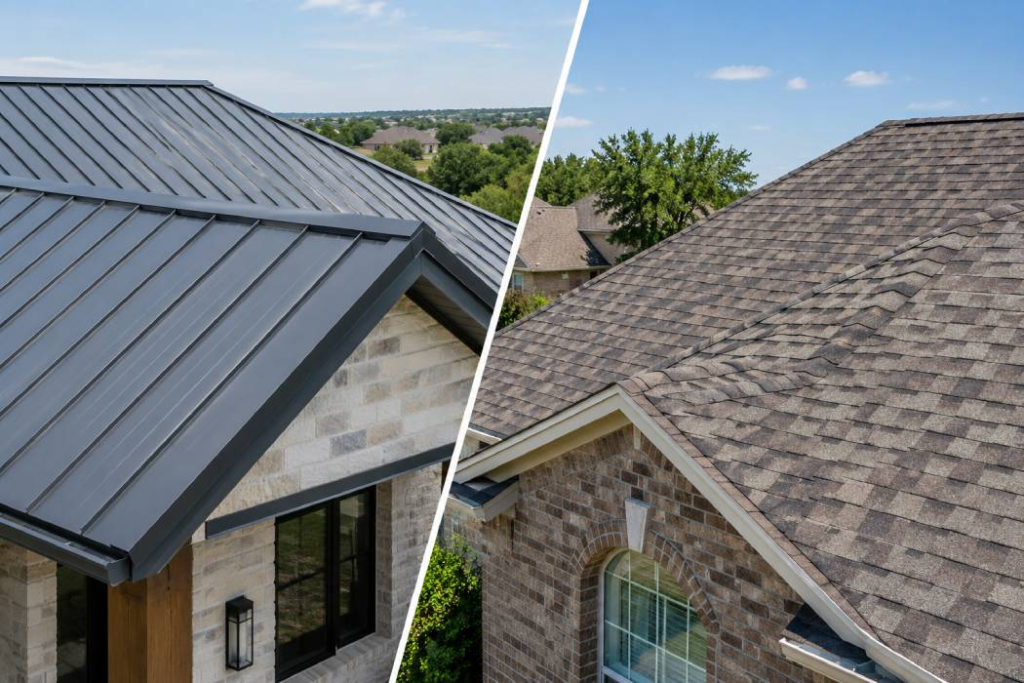
If you’re planning a roof replacement in Dallas Fort Worth, one of the biggest decisions you’ll face is the material itself. Asphalt shingles remain the most common choice across North Texas, but metal roofing has been gaining ground, especially among homeowners looking for something that holds up better against hail and lasts longer overall. Neither option is universally “better.” The right choice depends on your budget, how long you plan to stay in the home, and how much weight you put on long term durability versus upfront cost.
This decision tends to come up at one of two moments: either a roof is nearing the end of its life and it’s simply time to plan a roof replacement, or a roof has taken enough storm damage that repair no longer makes sense and replacement is the more practical path forward. Either way, it’s worth understanding how these two materials actually perform in Texas conditions before committing to one.
How Shingle Roofing Performs in Texas
Asphalt shingles are popular for good reason. They’re widely available, relatively inexpensive to install, and easy for most roofing crews to work with, which keeps both material and labor costs manageable. Shingle roofs typically last 15 to 25 years depending on the specific product and how well the roof is maintained.
The tradeoff is that shingles are more vulnerable to hail impact than metal. A significant hailstorm, common across DFW during spring and early summer, can bruise or crack shingles even without an obvious hole. This is one reason shingle roofing often needs closer inspection after severe weather compared to more impact resistant materials. Shingles also tend to lose granules over time, both from age and from hail exposure, which gradually reduces the material’s ability to protect against UV rays and moisture even before a leak develops.
On the plus side, because asphalt shingles are so common, matching an existing roof after a partial repair is generally straightforward, and almost every roofing crew in the DFW area is comfortable working with the material. That widespread familiarity keeps both repair costs and repair timelines more predictable than with less common materials.
How Metal Roofing Performs in Texas
Metal roofing has a reputation for durability that generally holds up. A quality metal roof can last 40 to 70 years, resists impact damage from hail far better than asphalt shingles, and reflects heat rather than absorbing it, which can modestly reduce cooling costs during Texas summers. Metal is also less prone to the kind of wind uplift that can tear shingles away during severe storms, provided it’s installed correctly.
The main tradeoff is upfront cost. Metal roofing typically costs more per square foot to install than asphalt shingles, sometimes significantly more depending on the specific style and finish chosen. For homeowners planning to stay in their home long term, that higher upfront investment often pays off through fewer repairs and a much longer replacement cycle. Standing seam panels, one of the more popular metal roofing styles in the DFW area, also tend to shed hail impact as a dent rather than a crack, which means the roof’s water-shedding ability generally stays intact even after a fairly severe storm.
Metal roofing does require a more specialized installation crew than asphalt shingles. Panel seams, fastener spacing, and flashing details all need to be handled correctly to get the performance and lifespan the material is known for, so it’s worth confirming that whoever installs a metal roof has specific experience with that material, not just general roofing experience.
Side by Side Comparison
| Asphalt Shingles | Metal Roofing | |
|---|---|---|
| Typical lifespan | 15 to 25 years | 40 to 70 years |
| Hail resistance | Moderate, prone to bruising | Higher, dents rather than cracks |
| Upfront cost | Lower | Higher |
| Heat reflectivity | Lower | Higher |
| Wind resistance | Moderate | Higher when properly installed |
| Repair availability | Widely available, easy matching | Requires more specialized crews |
Cost Considerations Beyond the Install
Sticker price is only part of the equation. Shingle roofs are generally cheaper to repair when isolated damage occurs, since matching materials and finding qualified crews is straightforward almost anywhere. Metal roofs, while more resistant to damage in the first place, can be more involved to repair if something does go wrong, simply because fewer crews specialize in metal work.
Insurance is another factor worth considering. According to Forbes Advisor, an analysis comparing multiple home insurance companies found metal roofing to be the least expensive roofing material to insure, with wood roofing landing at the opposite end as the most costly to cover. This is worth asking your insurance agent about directly, since the potential savings over time can offset some of the higher upfront material cost. It’s also a good idea to ask specifically about hail and wind endorsements, since those are the perils most likely to affect a DFW roof, and coverage details for those can vary more between insurers than the base policy does.
Financing is worth factoring in as well. Because metal roofing carries a higher upfront cost, some homeowners choose to spread that cost out through a financing option rather than paying the full amount at once, which can make the long term savings on maintenance and replacement more accessible even on a tighter monthly budget.
Which Homeowners Tend to Choose Which Material
There’s no universal right answer, but a few patterns tend to hold true:
- Homeowners planning to stay in their home for 10 or more years often lean toward metal for the long term durability and lower total cost of ownership over time.
- Homeowners preparing a home for sale, or working with a tighter renovation budget, often choose shingles for the lower upfront cost.
- Properties in areas with a history of significant hail damage sometimes prioritize metal specifically for its impact resistance, even at a higher initial cost.
- Homeowners who prioritize matching a specific architectural style, especially traditional or colonial designs, often stick with shingles for aesthetic reasons.
Whichever direction feels like the right fit on paper, it’s still worth having a contractor walk the specific roof in question. Roof pitch, the condition of the existing decking, and even the home’s orientation relative to prevailing wind and sun exposure can all shift the math in favor of one material over the other for a particular house, even if the general guidance above points the other way.
Frequently Asked Questions
Is metal roofing noisier during rain?
With proper installation, including solid decking and insulation underneath, metal roofs are not noticeably louder than shingle roofs during rain.
Can you install metal roofing over existing shingles?
In some cases, yes, though a full tear off is often recommended to properly inspect the decking underneath and ensure a clean installation.
Does metal roofing attract more lightning strikes?
No. Metal is not more likely to attract lightning, and in the rare event of a strike, metal roofing is actually less likely to catch fire compared to combustible roofing materials.
How do I know which material is the better fit for my specific home?
The best way to know is to have a contractor evaluate the roof directly, since factors like roof pitch, existing decking condition, sun exposure, and how long you plan to stay in the home all affect which material makes more financial sense. A roof inspection is a useful first step even if you’re leaning toward a replacement rather than a repair, since it gives you a clear baseline on the current roof’s condition before comparing materials for what comes next.
For general information on roofing material standards, wind resistance testing, and installation guidance, the National Roofing Contractors Association publishes consumer resources covering both metal and asphalt shingle roofing. For a broader look at how roofing material choice can affect homeowners insurance costs, Forbes Advisor’s guide to roof damage claims includes data comparing insurance rates across different roofing materials.